What Does a Chiropractor Do?
Written by Dr. Mariah and Dr. Sam, Doctors of Chiropractic | The Kingdom Chiropractic, Fishers, IN
Reviewed by Dr. Mariah, D.C. | Last updated: October 2026
Now that back-to-school routines have settled and fall wellness planning is underway, a lot of families in Fishers are taking stock of their health. And for many, that raises a basic question they've never had a straight answer to: what does a chiropractor do, exactly?
It's a fair question. Chiropractic is one of the more misunderstood healthcare professions. Some people picture a back-cracker. Others assume it's only for injuries. Neither picture is accurate. At The Kingdom Chiropractic in Fishers, IN, we'd rather give you an honest, complete explanation than a marketing pitch. That includes what chiropractic care involves, what training stands behind it, what we treat, and just as importantly, what we don't.
The Training Behind the Title
A Doctor of Chiropractic (D.C.) completes a rigorous, accredited graduate program after undergraduate study. Chiropractic education typically spans roughly four academic years and includes coursework in anatomy, physiology, neurology, radiology, pathology, orthopedics, biomechanics, and clinical diagnosis, followed by supervised clinical training with real patients.
Graduates must then pass national board examinations and obtain state licensure. In Indiana, chiropractors are licensed healthcare providers regulated by the Indiana Board of Chiropractic Examiners.
At our Fishers office, Dr. Mariah and Dr. Sam are both licensed Doctors of Chiropractic with specific training in neurologically based and family care, including gentle pediatric technique. You can read more about their individual backgrounds, training path, and philosophy on our About page.
We mention this because credentials matter, especially in healthcare content. You should know who is giving you information and what qualifies them to give it.
What a Chiropractor Actually Does: The Core Work
Chiropractic care centers on the relationship between your spine and your nervous system. Here's the mechanism, explained plainly.
Your nervous system (brain, spinal cord, and the nerves branching out from it) controls every function in your body. Your spine houses and protects that system. When a vertebra loses proper position or motion, chiropractors call this a subluxation, a misalignment that can interfere with nerve communication between the brain and body.
That interference doesn't always cause pain. It can affect how well the body coordinates, regulates, and repairs itself. Correcting the subluxation is intended to reduce that interference and restore clearer communication.
This is what we mean by healing at the source: rather than treating each symptom in isolation, we address the underlying interference. Our resource on the role of your nervous system in chiropractic care explains this brain-body relationship in more detail.
The Three Parts of Chiropractic Care
Day to day, the work breaks down into three components.
Assessment
Every patient relationship starts here. At our Fishers office, an initial assessment includes a detailed health history, a discussion of your symptoms and daily life, a postural evaluation, range of motion testing, and a hands-on examination of how each segment of your spine moves. We're identifying where restriction and misalignment exist, and where they don't.
We never adjust before we assess. That's not a policy we advertise; it's basic clinical practice.
Adjustment
The adjustment is a precise, controlled force applied to a specific spinal joint to restore proper motion. It's targeted, not general.
Technique varies by patient. Options include traditional manual adjustment, low-force techniques, instrument-assisted adjustment, and drop-table methods. The approach is selected based on your age, body, condition, and comfort level. An infant adjustment uses roughly the pressure you'd apply to check a ripe tomato. A collegiate athlete's adjustment looks entirely different.
Some adjustments produce an audible pop. That sound is gas releasing from joint fluid, the same phenomenon as cracking your knuckles. It is not bone on bone, and its absence doesn't mean the adjustment failed.
Ongoing Care and Guidance
Subluxations typically develop over months or years, so correcting them takes consistency. Care usually begins more frequently and tapers as the spine stabilizes.
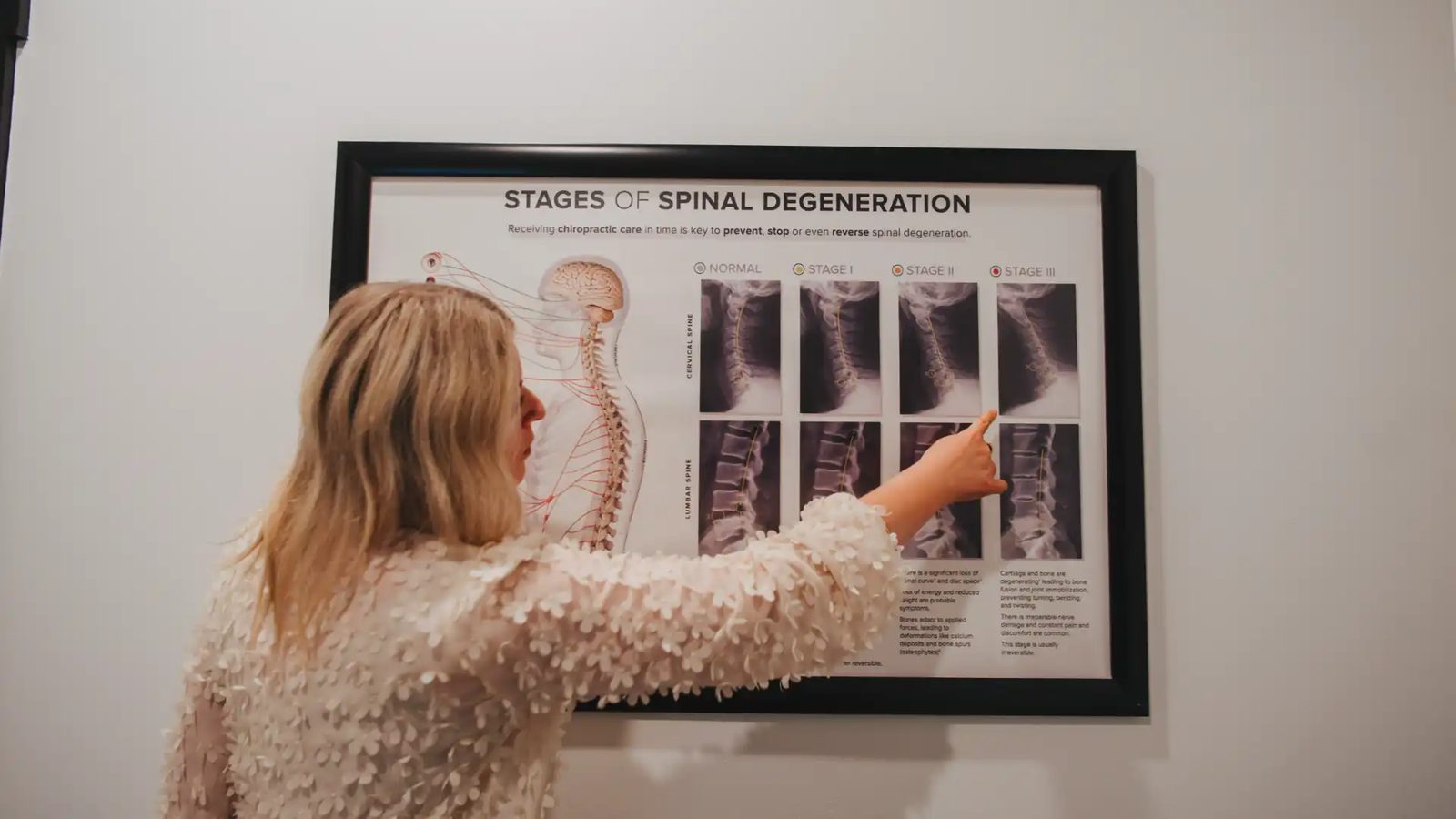
Alongside adjustments, we discuss the daily factors that affect spinal health: posture, workstation setup, sleep position, movement habits, and stress. To see how subluxations progress over time when left unaddressed, our phases of degeneration page explains the stages.
What Chiropractors Commonly Address
Chiropractic care is most often sought for concerns involving the spine, nervous system, and musculoskeletal function:
- Neck pain and stiffness
- Low back pain
- Headaches, particularly cervicogenic headaches originating in the neck
- Sciatica and radiating nerve symptoms
- Postural problems, including forward head posture from device use
- Joint restriction and reduced range of motion
- Sports-related strain and recovery support
- Pregnancy-related discomfort
- Pediatric concerns related to spinal development
Many patients also pursue chiropractic care for general wellness rather than a specific complaint, seeking support for sleep, energy, and overall function.
The American Chiropractic Association recognizes chiropractic as a safe, effective, drug-free approach for a range of common musculoskeletal conditions.
What Chiropractic Does Not Do
This section matters more than the one above it, and most practice websites leave it out.
Chiropractic care does not treat infections, cancer, diabetes, heart disease, or other systemic illness. We do not prescribe medication. We do not perform surgery. We do not manage psychiatric conditions.
Chiropractic care complements medical care. It does not replace it. If you have a condition requiring medical management, you should be under the care of a physician, and chiropractic care can sit alongside that, not instead of it.
There are also situations where you should seek medical evaluation rather than chiropractic care first. These include:
- Sudden, severe headache unlike any you've had before
- Loss of bowel or bladder control alongside back pain
- Progressive weakness or numbness in a limb
- Pain following significant trauma such as a car accident or fall, before imaging
- Unexplained weight loss accompanying back pain
- Fever with spinal pain
If you present with any of these, we will refer you out. The Mayo Clinic provides useful guidance on back and neck symptoms that warrant prompt medical attention.
Being clear about limits isn't a weakness in a healthcare provider. It's a requirement.
Chiropractor vs. Physical Therapist: The Practical Difference
This comes up constantly, so here's a straightforward comparison.
A chiropractor focuses primarily on spinal alignment and nervous system function, using adjustments to restore joint motion and reduce nerve interference. Care tends to center on the spine itself.
A physical therapist focuses primarily on rehabilitation through therapeutic exercise, manual therapy, and movement retraining, often working to rebuild strength and function after injury or surgery.
The two are not in competition, and they overlap. Plenty of patients benefit from both. A useful way to think about it: chiropractic often addresses structural and neurological interference, while physical therapy often addresses functional strength and movement patterns. Which you need depends on your situation, and an honest provider will tell you if you're in the wrong office.
Practical Questions: Cost, Referrals, and Insurance
Let's answer the practical questions directly rather than making you call to find out.
Do you need a referral? In Indiana, chiropractors have direct access status, meaning you can see a chiropractor without a physician's referral. Some insurance plans may still require one for coverage purposes, so it's worth checking your specific plan.
Does insurance cover it? Many plans include chiropractic benefits, though coverage varies significantly by plan, visit limits, and whether the provider is in network. Health Savings Account and Flexible Spending Account funds can typically be applied to chiropractic care as well.
What does it cost? Initial visits, which include consultation, examination, and report of findings, cost more than routine follow-up visits. At our Fishers office, the $49 New Patient Special covers your consultation and assessment, so you can find out what's going on and what care would involve before committing to anything. We'll give you clear pricing at your report of findings, not after treatment begins.
If you'd like a full walkthrough of a first appointment, our What To Expect page covers it step by step.
What This Looks Like at Our Fishers Office
Our practice sits along the 96th Street corridor, serving families throughout Fishers and the Geist area.
We practice neurologically based chiropractic, meaning our focus extends beyond pain relief to nervous system function. We care for every age, from newborns through seniors, using technique adapted to each patient. You can see the full range of what we offer on our Chiropractic Services page.
What patients consistently tell us they notice: we explain things before we do them, we don't rush the consultation, and we'll tell you honestly when chiropractic isn't the right answer for what you're dealing with.
Visit Our Fishers Chiropractic Office
Our office is conveniently located along the 96th Street corridor, easily accessible from anywhere in Fishers, Indiana.
The Kingdom Chiropractic
8924 E 96th Street
Fishers, IN 46037
Phone: (317) 588-9414
Office Hours:
- Monday: 9:30am-12pm, 3-6pm
- Tuesday: 8:30-11:30am
- Wednesday: 9:30am-12pm, 3-6pm
- Thursday: 3-6pm
- Friday-Sunday: Closed
Have Questions? Come Get Straight Answers
If you've read this far, you're doing exactly what we'd hope: gathering real information before making a healthcare decision. The next step is simply finding out whether chiropractic care fits your situation.
Our $49 New Patient Special covers a thorough consultation, a complete assessment, and a clear report of findings. You'll leave knowing what's going on with your spine, what we'd recommend, and what it would cost. If chiropractic isn't the right fit, we'll tell you that too.
Fall is a natural time to get your health sorted before the holidays. No pressure, no obligation, just answers.
📞 Call us today at (317) 588-9414
📍 Visit us at 8924 E 96th Street, Fishers, IN 46037
🌐 Book your appointment online
Frequently Asked Questions
How much does a chiropractor visit cost in Fishers?
Initial visits cost more than follow-ups because they include consultation, examination, and a report of findings. At our Fishers office, the $49 New Patient Special covers your consultation and assessment. We provide clear pricing for any recommended care at your report of findings, before treatment begins.
Do I need a referral to see a chiropractor in Indiana?
No. Indiana has direct access, so you can see a chiropractor without a physician's referral. Some insurance plans may still require a referral for coverage purposes, so check your specific plan if you intend to use benefits.
Does insurance cover chiropractic care?
Many plans include chiropractic benefits, though coverage varies by plan, visit limits, and network status. HSA and FSA funds can typically be applied to chiropractic care. We're happy to help you understand your benefits when you book.
What is the difference between a chiropractor and a physical therapist?
Chiropractors focus primarily on spinal alignment and nervous system function, using adjustments to restore joint motion. Physical therapists focus primarily on rehabilitation through therapeutic exercise and movement retraining. The disciplines overlap, and many patients benefit from both.
What conditions do chiropractors treat?
Common concerns include neck and back pain, headaches, sciatica, postural problems, joint restriction, sports strain, pregnancy-related discomfort, and pediatric spinal development. Many patients also seek care for general wellness rather than a specific complaint.
What does chiropractic care not treat?
Chiropractic does not treat infections, cancer, diabetes, heart disease, or other systemic illness, and chiropractors do not prescribe medication or perform surgery. Chiropractic complements medical care and does not replace it.
Is a chiropractor a real doctor?
A Doctor of Chiropractic (D.C.) completes an accredited graduate program covering anatomy, neurology, radiology, diagnosis, and supervised clinical training, then passes national board exams and obtains state licensure. Chiropractors are licensed healthcare providers with a defined scope of practice that differs from that of a medical doctor.
Ready to Experience Better Health?
Take the first step towards optimal wellness with personalized chiropractic care at The Kingdom Chiropractic.
Related Articles
Holistic Chiropractor Near Me
Looking for a holistic chiropractor near me in Fishers? Learn how nutrition, sleep, stress, and movement support whole-body wellness this fall.
What Happens During Chiropractic Spinal Manipulation?
Nervous about your first visit? Walk through chiropractic spinal manipulation step by step at our Fishers office. Book your visit today.
Family Chiropractor Near Me in Fishers, IN
Looking for a family chiropractor near me in Fishers? See how one practice supports every generation, from infants to seniors, all year long.